Websites for seasonal and membership campgrounds
You're filling a season, not a Tuesday night
You're not filling a site for a Tuesday. You're filling a season, sometimes a waitlist three years deep, and the website that does that job looks almost nothing like a nightly-booking site.
or write hello@campgroundwebdesigner.com
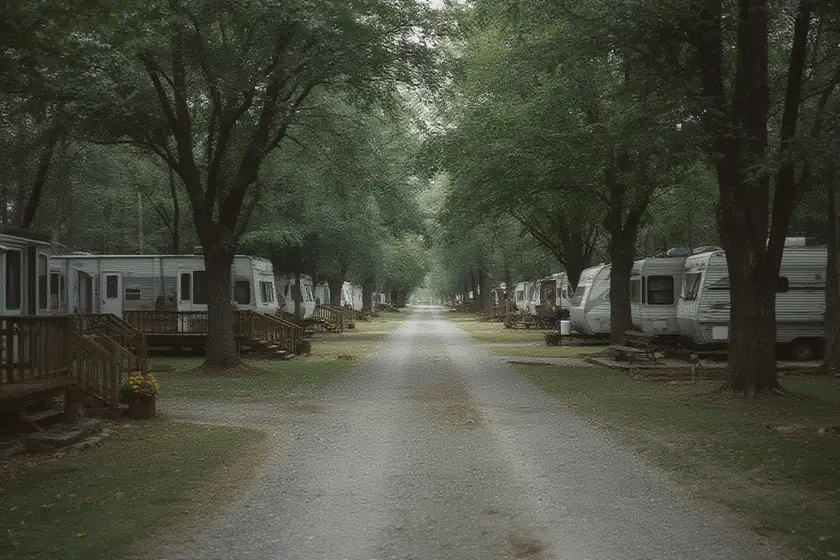 Seasonal and membership
Usually
- Complete$7,500
Paid onceNo monthly bill
Campground Web Designer: the facts
| Service | Web design, fixed price, in three sizes |
|---|---|
| Price range | $2,800–$7,500 USD |
| Serves | United States, Canada |
| Based in | Fort Erie, Ontario, working remotely |
| Phone | 866.268.2930 |
| hello@campgroundwebdesigner.com |
A hotel room and an apartment are both places to sleep, and they are not the same transaction. Nobody signs a lease from a phone at a rest stop. There's an application, a conversation, references, a deposit, rules to read, and a decision that takes weeks because it commits you for a year. The website for a landlord and the website for a hotel should therefore share almost nothing except the address.
That's your park. A seasonal site or a membership is a lease. The person considering it is going to park a trailer on your ground for six months, meet the neighbors, and come back next year. They are making a slow, expensive, social decision, and a website built for a two-minute nightly booking will handle it badly at both ends.
Membership and seasonal parks are usually a good fit for the Complete build at $7,500.
The application, not the booking button
The centerpiece of a seasonal site is the application form, and it earns its keep by doing two jobs at once: qualifying the applicant and setting expectations before anybody's disappointed.
What that looks like in practice:
- A real application that collects rig type, length, age and condition where that matters to your rules, household size, pets, vehicles, and preferred section
- The rules, the fees, and what's included stated on the page *before* the form, so nobody applies and then discovers your ten-year rig policy
- A waitlist flow that tells an applicant where they stand and when you review the list, because "we'll be in touch" is how you lose people who would have waited happily if they'd known the timeline
- Confirmation that actually confirms, so the applicant isn't emailing the office in three days to ask whether the form went through
- Everything landing somewhere you can sort it, rather than as forty unstructured emails you'll be scrolling through in April
The blunt version: an application form that takes ninety seconds to fill in gets you a pile of applicants who haven't read anything. One that takes eight minutes and states the rules up front gets you a shorter list of people who actually want the season you're selling. Shorter is better here. You're not trying to maximize volume. You're trying to fill a finite number of sites with people who'll renew.
Member-facing pages are the other half of the site
Public pages sell the season. Member pages run it, and they are the part almost every seasonal park's website is missing.
Your office answers the same questions every year in the same order: when does water go on, when do I have to be winterized by, what are the guest rules, what's the speed limit, how do I pay, when is the AGM, who do I call about the gate code. Every one of those is a page. Written once, updated once a year, and it stops being a phone call.
A member area typically holds:
- Season dates, opening and closing procedures, and the winterization deadline
- The rules document in a version people can actually read on a phone, not a scanned PDF from 2011
- Renewal information, deadlines, and how payment works
- Notices: water shutoffs, road work, burn bans, the things you currently put on a whiteboard at the gate
- Forms members need every year, in one place, so nobody calls to ask where they went
Whether that sits behind a login or just lives at a quiet URL is a decision we make together. Plenty of parks are better served by a simple unlisted section than by a login system that generates its own support calls every spring. I'll tell you honestly which one your park actually needs, and a login is not automatically the better answer.
What this site is not
It isn't a nightly-booking site, and I'd rather not blur the two. If your park also rents transient sites by the night, that's a different section with different language and often a booking platform behind it, and the independent campground build covers that job.
It also isn't a reservation engine. I build the website, the application flow, and the member-facing information. Deposits, inventory, and site assignment belong to your booking or park-management software, and I connect to it rather than replacing it. If that line is fuzzy for you, this walks through it: do I need Campspot or RoverPass if I already have a website?
What you get
Complete covers the full picture: everything in Grow (the ten-page build with a page and gallery for each site type or unit), plus the application or waitlist flow built for a slow high-commitment funnel, the member-facing area for rules and renewals and notices, and enough structure underneath that you can add a section, a second property, or a whole new membership tier later without paying for a rebuild.
The domain, the hosting account, and every file are registered in your business name from day one. For a park that's been operating for thirty years and expects to operate for thirty more, that matters more than any single design decision on the site.
Pricing shown in USD. See Canadian-dollar pricing →
Common questions
Do members need logins?
Sometimes. Often a well-organized section that isn't linked from the main menu does the job with none of the password-reset calls. We decide that based on what's actually behind the door.
Can the site take seasonal payments?
Payment processing usually belongs with your park-management software, and I'll link the site to it cleanly. If you're taking checks and bank transfers today and that works, the site doesn't need to change it.
We have a Facebook group members already use. Do we need this?
Keep the group, it's genuinely useful for the day-to-day. But a group is rented ground, the posts scroll away, and a member looking for the winterization deadline at eleven at night will not find it under four months of photos. Put the permanent answers somewhere permanent.
How long does it take?
Plan for the off-season. Start in November or January, launch well before applications open, because the worst week to change how your application works is the week people are using it.
Do I own it?
Yes, and for a park planning on another thirty years, that outlasts any single design decision on the site. Domain, hosting, files, logins, all in your business name from the day it launches.
Tell me about your park
How many seasonal sites, whether you run a waitlist, and what your office is answering on the phone most often between March and May. That last one is usually the site map. If the site's fine and the listing is what's actually lagging, CampgroundSEO's membership-seasonal page covers that instead.
Email hello@campgroundwebdesigner.com.
Ready to get a fixed-price quote?
Write to hello@campgroundwebdesigner.com. I reply within one business day.