Websites for glamping and unique-stay operators
If you're charging boutique-hotel money, the site can't look photocopied
If you're charging boutique-hotel money for a night in a dome, the website has to look like the product. And every booking that arrives through a listing platform arrives with a bite taken out of it.
or write hello@campgroundwebdesigner.com
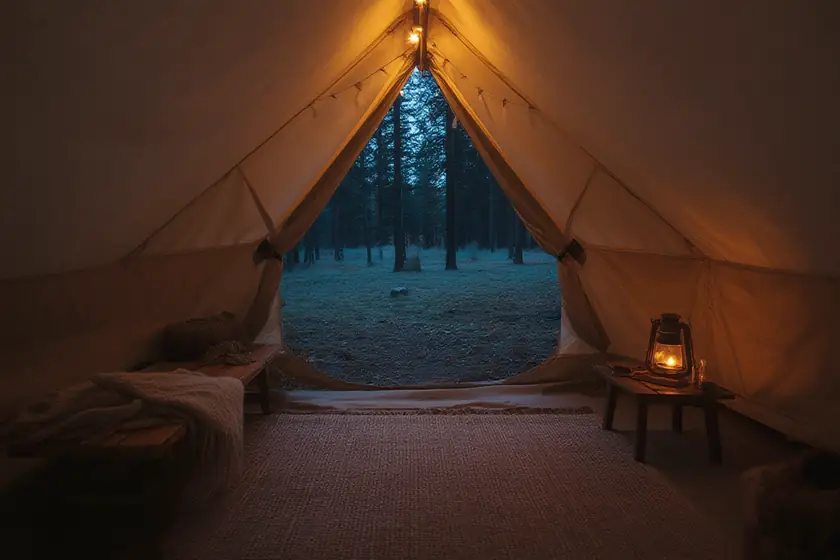 Glamping
Usually
- Grow$4,500
Paid onceNo monthly bill
Campground Web Designer: the facts
| Service | Web design, fixed price, in three sizes |
|---|---|
| Price range | $2,800–$7,500 USD |
| Serves | United States, Canada |
| Based in | Fort Erie, Ontario, working remotely |
| Phone | 866.268.2930 |
| hello@campgroundwebdesigner.com |
Two restaurants, same street, same food. One hands you a photocopied sheet in a plastic sleeve. The other hands you a printed menu on good paper. Both list the same chicken at the same price, and you will believe the second one is worth it and doubt the first. Nothing about the chicken changed.
That's the whole problem with a glamping website. You have built something genuinely nice, you're asking $250 or $400 a night for it, and if the website looks like a 2013 campground template with a rate table on it, the guest quietly recalibrates what they think the night is worth. Presentation is not vanity in this segment. It's the price.
Most glamping and unique-stay sites are a good fit for the Grow build at $4,500.
Gallery-first, because the photo is the product
For an RV park, the photos support the information. For a yurt, a safari tent, a dome, a treehouse, or a converted airstream, the photos *are* the information. Nobody has stayed in a dome before. They cannot picture it. The picture is the entire sales argument.
So the build starts from the images and the text fits around them:
- Full-width photography at the top of every unit page, sized properly so it stays sharp on a phone and still loads quickly
- One gallery per unit type, not one site-wide dump. A guest booking the treehouse should never have to scroll past the safari tents
- Interior, exterior, bed, bathroom, and view, in that order, for every single unit. The two questions you get asked most are "what does the bathroom situation actually look like" and "what do I see when I open the door"
- Captions that answer a question rather than describing what the reader can already see
- Seasonal sets, if your property looks like a different place in October than it does in July
If your photos aren't there yet, that's a fixable problem and you probably don't need to hire a crew for it. I wrote the practical version here: how to photograph your campground for the website without hiring a drone crew.
A page per unit type, with a story attached
Ten identical RV sites need one page. Five different units need five pages, because they are five different products and a guest is choosing between them, not between you and the place down the road.
Each unit page carries its own photography, its own rate and minimum stay, its own honest amenity list, and a short piece of writing about what staying in that particular unit is actually like. The dome with the skylight over the bed. The cabin that's a four-minute walk from the parking area, which matters if you're bringing a cooler. The tent that gets the morning sun.
That writing does real work. It is the difference between a listing and a place, and it is also the part that a template platform cannot do for you, because it's about your property specifically.
Amenity honesty applies here even harder than it does at an RV park. Composting toilet, shared bathhouse, no electricity after ten, a five-minute walk in the dark: say it plainly on the page. The guest who was going to be upset self-selects out before they book, and the guest who reads it and books anyway arrives with the right expectations. Your review average is largely decided before anyone checks in.
Own your booking page
Here's the arithmetic behind that.
A booking that arrives through a listing marketplace costs you a percentage. Depending on the platform and how the fees are split, somewhere in the range of ten to twenty percent of the night is gone before you've turned a bed. On a $400 unit running a decent occupancy, that's a meaningful piece of your season handed to a company for the introduction.
The introduction is worth paying for the first time. It is not worth paying for the fourth time, when the guest already knows your name, already loved the stay, and is typing your property into a search bar to come back.
That's what a direct site is for. When somebody arrives who already knows who you are, the site's only job is to make booking direct the easy and obvious path: a clear inquiry or booking button, your own rates visible without a login, a returning-guest note, and no dead ends that send them back to the marketplace out of frustration.
To be plain about scope: I build the website and the inquiry path, not the reservation engine. If you're running a booking platform already, I connect to it. If you're not sure whether you need one, start here: do I need Campspot or RoverPass if I already have a website? And the page-by-page split between the two is here: what actually belongs on a campground website versus a booking platform.
Keep the listings. They're good marketing. Just stop paying rent on customers you already earned.
What you get
Grow covers a property with several unit types: up to ten pages, a dedicated page and gallery for each unit, a news or events page you update yourself, and the amenity and directions pages that cut your inbox down. If you're running one or two units and want a simple, sharp presence, Starter at $2,800 is often enough.
The domain, the hosting account, and every file are registered in your business name. If you built your presence on a template platform and it's stuck there, this is the difference that matters most.
Pricing shown in USD. See Canadian-dollar pricing →
Common questions
Will it look as good as the platform templates?
That's the intent, and it's the reason this segment usually lands on Grow rather than Starter. The difference is that when you outgrow it, want to redesign it, or want to move it, you can. A template tied to a vendor's platform generally doesn't travel. The vendors in this space are legitimate and some of their photo work is genuinely good, so this isn't a knock on the pictures. It's a question about whose name is on the domain.
Can I take direct bookings and stay on Airbnb and Hipcamp?
Yes, and most operators should do exactly that. The listings bring you new people. The website keeps the repeat ones off the fee.
I have great phone photos already. Is that enough?
Often, yes. Modern phones shoot better than most of what was on the web ten years ago. What usually needs fixing is the light and the tidying, not the camera. The photography guide covers it.
Do I own the site?
Yes, and unlike a platform template, it isn't tied to anyone else's system if you ever want to move it. Domain, hosting, files, logins, all in your business name from launch day.
Tell me about your property
How many units, what kinds, what you charge, and where your bookings come from right now. That last answer usually shows me exactly where the money is leaking. If the site already looks the part and the listing is the gap, CampgroundSEO's glamping page covers that instead.
Email hello@campgroundwebdesigner.com.
Ready to get a fixed-price quote?
Write to hello@campgroundwebdesigner.com. I reply within one business day.